

Полупроводниковые приборы в России
+7 (812) 240-88-50
+7 (812) 240-88-50
г. Санкт-Петербург, ул. Софийская 17, лит.А, помещение 3Н оф.230
info@texasinst.ru
...
Каталог товаров
Преобразование логики и напряжения
Управление питанием
...
Каталог товаров
Преобразование логики и напряжения
Управление питанием
Поиск
Каталог товаров
Назад
DLP компоненты
Назад
3D scan & machine vision products
Automotive products
Display & projection products
RF & microwave
Назад
Mixers & modulators
RF amplifiers
Wideband transceivers, receivers, transmitters
Аудио
Назад
Audio converters
Audio interface ICs
Specialty audio ICs
Датчики
Назад
Датчики температуры
Магнитные датчики
Радиолокационные датчики миллиметрового диапазона
Драйверы двигателей
Назад
Actuator drivers
Brushless DC (BLDC) motor drivers
Изоляторы
Назад
Isolated interface ICs
Power for signal isolators
Интерфейсы
Назад
Circuit protection ICs
Ethernet ICs
High-speed SerDes
Коммутаторы и мультиплексоры
Микроконтроллеры (MCUs) и процессоры
Преобразование логики и напряжения
Назад
Buffers, drivers & transceiver
Flip-flops, latches & registers
Voltage translators & level shifters
Преобразователи данных
Назад
Аналого-цифровые преобразователи (АЦП)
Интегрированные и специальные функциональные преобразователи данных
Цифроаналоговые преобразователи (ЦАП)
Управление питанием
Назад
AC/DC & isolated DC/DC switching regulators
Battery management ICs
DC/DC switching regulators
Digital power ICs
Gate drivers
MOSFETs
Power over Ethernet (PoE) ICs
Voltage references
Усилители
Назад
Operational amplifiers (op amps)
Назад
Часы и генераторы времени
ISO3086T Texas instruments

ISO3086T
Уточнить цену
ISO3086T
Уточнить цену
СРАВНИТЬ
В СРАВНЕНИИ
Уточнить цену
Описание
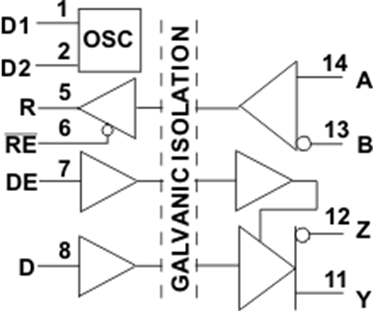
The ISO3086T is an isolated differential line transceiver with integrated oscillator
outputs that provide the primary voltage for an isolation transformer. The device is a full-duplex
differential line transceiver for RS-485 and RS-422 applications that can easily be configured for
half-duplex operation by connecting pin 11 to pin 14, and pin 12 to pin 13.
These devices are ideal for long transmission lines since the ground loop is broken to
allow for a much larger common-mode voltage range. The symmetrical isolation barrier of the device
is tested to provide 4242 VPK of isolation for 1 minute per VDE between the
bus-line transceiver and the logic-level interface.
Any cabled I/O can be subjected to electrical noise transients from various sources.
These noise transients can cause damage to the transceiver and/or near-by sensitive circuitry if
they are of sufficient magnitude and duration. These isolated devices can significantly increase
protection and reduce the risk of damage to expensive control circuits.
The ISO3086T is specified for use from 40°C to 85°C.
- Meets or Exceeds TIA/EIA-485-A
- Signaling Rate up to 20 Mbps
- 1/8 Unit Load – Up to 256 Nodes on a Bus
- Thermal Shutdown Protection
- Typical Efficiency > 60% (ILOAD = 100 mA) -
see SLUU469 - Low Bus Capacitance 7 pF (Typ)
- 50-kV/µs Typical Transient Immunity
- Fail-safe Receiver for Bus Open, Short, Idle
- Logic Inputs are 5-V Tolerant
- Bus-Pin ESD Protection
- 11-kV HBM Between Bus-Pins and GND2
- 6-kV HBM Between Bus-Pins and GND1
- Safety and Regulatory Approvals
- 4242 VPK Basic Insulation per DIN V VDE V
0884-10 and DIN EN 61010-1 - 2500 VRMS Isolation for 1 minute per UL 1577
- CSA Component Acceptance Notice 5A, IEC
60950-1 and IEC 61010-1 Standards
- 4242 VPK Basic Insulation per DIN V VDE V
| Type | RS-485 |
| Data rate (max) (MBits) | 20 |
| Operating temperature range (°C) | -40 to 85 |
| Rating | Catalog |
| CMTI (min) (kV/µs) | 25 |
| Isolation rating | Basic |
| Surge isolation voltage (VIOSM) (VPK) | 4000 |
| Withstand isolation voltage (VISO) (Vrms) | 2500 |
| Working isolation voltage (VIOWM) (Vrms) | 400 |
| Transient isolation voltage (VIOTM) (VPK) | 4242 |
г. Санкт-Петербург, ул. Софийская 17, лит.А, помещение 3Н оф.230