

Полупроводниковые приборы в России
+7 (812) 240-88-50
+7 (812) 240-88-50
г. Санкт-Петербург, ул. Софийская 17, лит.А, помещение 3Н оф.230
info@texasinst.ru
...
Каталог товаров
Преобразование логики и напряжения
Управление питанием
...
Каталог товаров
Преобразование логики и напряжения
Управление питанием
Поиск
Каталог товаров
Назад
DLP компоненты
Назад
3D scan & machine vision products
Automotive products
Display & projection products
RF & microwave
Назад
Mixers & modulators
RF amplifiers
Wideband transceivers, receivers, transmitters
Аудио
Назад
Audio converters
Audio interface ICs
Specialty audio ICs
Датчики
Назад
Датчики температуры
Магнитные датчики
Радиолокационные датчики миллиметрового диапазона
Драйверы двигателей
Назад
Actuator drivers
Brushless DC (BLDC) motor drivers
Изоляторы
Назад
Isolated interface ICs
Power for signal isolators
Интерфейсы
Назад
Circuit protection ICs
Ethernet ICs
High-speed SerDes
Коммутаторы и мультиплексоры
Микроконтроллеры (MCUs) и процессоры
Преобразование логики и напряжения
Назад
Buffers, drivers & transceiver
Flip-flops, latches & registers
Voltage translators & level shifters
Преобразователи данных
Назад
Аналого-цифровые преобразователи (АЦП)
Интегрированные и специальные функциональные преобразователи данных
Цифроаналоговые преобразователи (ЦАП)
Управление питанием
Назад
AC/DC & isolated DC/DC switching regulators
Battery management ICs
DC/DC switching regulators
Digital power ICs
Gate drivers
MOSFETs
Power over Ethernet (PoE) ICs
Voltage references
Усилители
Назад
Operational amplifiers (op amps)
Назад
Часы и генераторы времени
/ / /
Other interfaces
/ RS-485 & RS-422 transceiversRS-232 transceiversOther interfacesCAN & LIN transceivers & SBCsUARTsCircuit protection ICsLVDS, M-LVDS & PECL ICsPCIe, SAS & SATA ICsUSB ICsHDMI, DisplayPort & MIPI ICsI2C ICsHigh-speed SerDesOptical networking ICsEthernet ICsMulti-switch detection interface (MSDI) ICsIO-Link & digital I/OsSerial digital interface (SDI) ICs
TLK10022 Texas instruments
TLK10022 Texas instruments

TLK10022
Уточнить цену
TLK10022
Уточнить цену
СРАВНИТЬ
В СРАВНЕНИИ
Уточнить цену
Описание
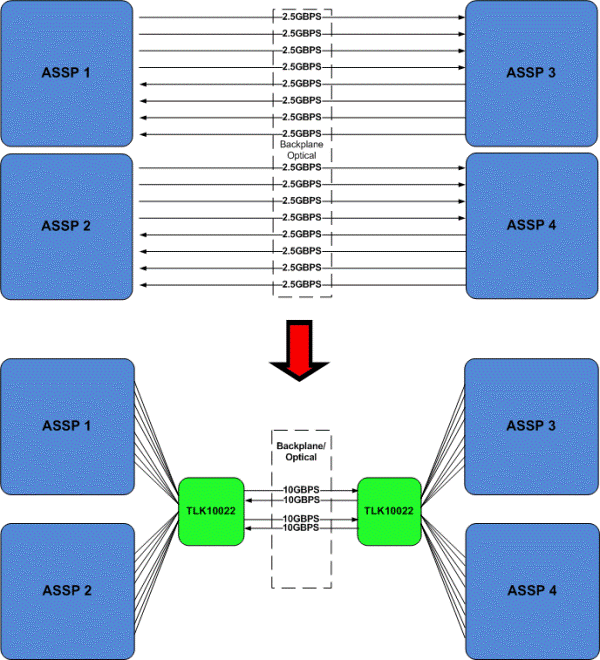
The TLK10022 is a dual-channel multi-rate link aggregator intended for use in
high-speed bi-directional point-to-point data transmission systems. The device allows for a
reduction in the number of physical links required for a certain data throughput by multiplexing
multiple lower-rate serial links into higher-rate serial links.
Each channel of the TLK10022 has a low-speed interface which can accommodate one, two,
three, or four bidirectional serial links running at rates from 250 Mbps to 5 Gbps (maximum of 10
Gbps total throughput). The device’s high speed interfaces (one per channel, bidirectional) can
operate at rates from 1 Gbps to 10 Gbps. When a channel is configured for a certain multiplexing
ratio (1-to-1, 2-to-1, 3-to-1, or 4-to-1), the high speed side will operate at a fixed multiple of
the low speed rate (e.g., four times faster for 4-to-1 mode) regardless of the number of lanes
connected. Filler data will be placed on any unused lanes in order to keep the interleaved lane
ordering constant. This allows for low speed lanes to be hot swapped during normal operation
without requiring a change in configuration.
The device has multiple interleaving/de-interleaving schemes that may be used depending
on the data type. These schemes allow for the low speed lane ordering to be recovered after the
lanes are transmitted over a single high-speed link. There is also a programmable
scrambling/de-scrambling function available to help ensure that the high-speed data has suitable
properties for transmission (i.e., sufficient transition density for clock recovery and DC balance
over time) even for non-ideal input data.
A 1:1 mode is also supported for data rates ranging from 0.5 Gbps to 2.5 Gbps, whereby
both low speed and high speed are rate matched. The TX and RX datapaths are also independent, so
the TX and RX can operates in different modes (this excludes 3:1 mode which requires both the TX
and RX path to run in the same mode). This independence is restricted to using the same low speed
line rate. For example, the TX can operate at 4 × 2.5 Gbps while RX operates at 1 x 2.5 Gbps.
The individual Low Speed lanes may also operate at independent rates in byte
interleave mode, provided they are operating at integer multiples. The High Speed line rate must be
configured based on the fastest Low Speed line rate.
The TLK10022 has the ability to perform lane alignment on 2, 3, or 4 lanes with up to
four bytes of lane de-skew.
Both the low speed and high speed side interfaces (transmitters and receivers) use CML
signaling with integrated termination resistors and feature programmable transmitter de-emphasis
levels and adaptive receive equalization to help compensate for media impairments at higher
frequencies. The device’s serial transceivers used are capable of interfacing to optical modules as
well as higher-loss connections such as PCB backplanes and controlled-impedance copper cabling.
To aid in system synchronization, the TLK10022 is capable of extracting clocking
information from the serial input data streams and outputting a recovered clock signal. This
recovered clock can be input to a jitter cleaner in order to provide a synchronized system clock.
The device also has two reference clock input ports and a flexible internal PLL, allowing for
various serial rates to be supported with a single reference clock input frequency.
The device has various built-in self-test features to aid with system validation and
debugging. Among these are pattern generation and verification on all serial lanes as well as
internal data loopback paths.
- Automatic Digital Multiplexing/De-Multiplexing of 4,
3, or 2 Independent Lower-Speed Gigabit Serial Lines
into a Single Higher-Speed Gigabit Serial Line - 4 × (0.25 to 2.5 Gbps) to 1 × (1 to 10 Gbps) Multiplexing
- 3 × (0.5 to 3.33 Gbps) to 1× (1.5 to 10 Gbps)
- 2 × (0.5 to 5 Gbps) to 1 × (1 to 10 Gbps)
- 1 × (0.5 to 2.5 Gbps) to 1 × (0.5 to 2.5 Gbps)
- Programmable Per Channel Lane Switching
- Wide Data Rate Range for Multiple Application Support
- Transmit De-Emphasis and Adaptive Receiver Equalization
on Both Low Speed and High Speed Sides - 8B/10B ENDEC Coding Support
- Raw (unencoded) Data Support
- Core Supply 1V; I/O: 1.5V/1.8V
- Programmable High Speed Scrambling/Descrambling Functions
Improve Serial Link Transition Density and Reduce Spectral Peaks - Superior Signal Integrity Performance
- Low Power Operation: < 800mW per Channel (typ)
- Flexible Clocking
- Multi Drive Capability (SFP+, backplane, cable)
- Support for Programmable Lane Marker Character
- Support for Programmable HS/LS 10-Bit Alignment Character
- Wide Range of Built-in Test Patterns
- 144-pin, 13mmx13mm FCBGA Package
| Protocols | Catalog |
| Rating | Catalog |
| Operating temperature range (°C) | -40 to 85 |
г. Санкт-Петербург, ул. Софийская 17, лит.А, помещение 3Н оф.230