

Полупроводниковые приборы в России
+7 (812) 240-88-50
+7 (812) 240-88-50
г. Санкт-Петербург, ул. Софийская 17, лит.А, помещение 3Н оф.230
info@texasinst.ru
...
Каталог товаров
Преобразование логики и напряжения
Управление питанием
...
Каталог товаров
Преобразование логики и напряжения
Управление питанием
Поиск
Каталог товаров
Назад
DLP компоненты
Назад
3D scan & machine vision products
Automotive products
Display & projection products
RF & microwave
Назад
Mixers & modulators
RF amplifiers
Wideband transceivers, receivers, transmitters
Аудио
Назад
Audio converters
Audio interface ICs
Specialty audio ICs
Датчики
Назад
Датчики температуры
Магнитные датчики
Радиолокационные датчики миллиметрового диапазона
Драйверы двигателей
Назад
Actuator drivers
Brushless DC (BLDC) motor drivers
Изоляторы
Назад
Isolated interface ICs
Power for signal isolators
Интерфейсы
Назад
Circuit protection ICs
Ethernet ICs
High-speed SerDes
Коммутаторы и мультиплексоры
Микроконтроллеры (MCUs) и процессоры
Преобразование логики и напряжения
Назад
Buffers, drivers & transceiver
Flip-flops, latches & registers
Voltage translators & level shifters
Преобразователи данных
Назад
Аналого-цифровые преобразователи (АЦП)
Интегрированные и специальные функциональные преобразователи данных
Цифроаналоговые преобразователи (ЦАП)
Управление питанием
Назад
AC/DC & isolated DC/DC switching regulators
Battery management ICs
DC/DC switching regulators
Digital power ICs
Gate drivers
MOSFETs
Power over Ethernet (PoE) ICs
Voltage references
Усилители
Назад
Operational amplifiers (op amps)
Назад
Часы и генераторы времени
/ / /
Optical networking ICs
/ RS-485 & RS-422 transceiversRS-232 transceiversOther interfacesCAN & LIN transceivers & SBCsUARTsCircuit protection ICsLVDS, M-LVDS & PECL ICsPCIe, SAS & SATA ICsUSB ICsHDMI, DisplayPort & MIPI ICsI2C ICsHigh-speed SerDesOptical networking ICsEthernet ICsMulti-switch detection interface (MSDI) ICsIO-Link & digital I/OsSerial digital interface (SDI) ICs
ONET2804TLP Texas instruments
ONET2804TLP Texas instruments

ONET2804TLP
Уточнить цену
ONET2804TLP
Уточнить цену
СРАВНИТЬ
В СРАВНЕНИИ
Уточнить цену
Описание
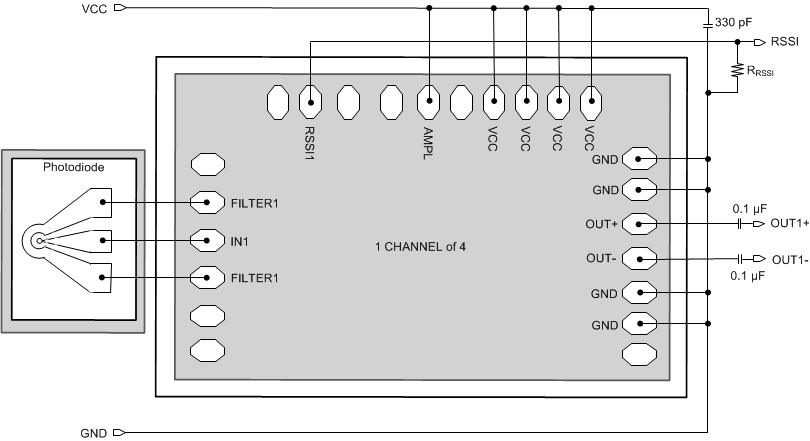
The ONET2804TLP device is a high-gain, limiting transimpedance amplifier (TIA) for parallel optical interconnects with data rates up to 28 Gbps. The device is used in conjunction with a 750-µm pitch photodiode array to convert an optical signal into a differential output voltage. An internal circuit provides the photodiode reverse bias voltage and senses the average photocurrent supplied to each photodiode. The device can be used with pin control or a two-wire serial interface to allow control of the output amplitude, gain, bandwidth, and input threshold. The ONET2804TLP provides 17.5-GHz bandwidth, a gain of 7.5 kΩ, an input-referred noise of 2 µArms, and a received signal strength indicator (RSSI) for each channel. 40-dB isolation between channels results in low crosstalk penalty in the receiver. The device requires a single 2.8-V to 3.3-V supply and typically dissipates 90 mW per channel with a differential output amplitude of 300 mVPP. The device is characterized for operation from –40°C to +100°C and is available in die form with a 750-µm channel pitch.
- 4-Channel Multi-Rate Operation: Up to 28 Gbps
- Dissipation at a 3-V Supply: 90 mW per Channel
- Differential Transimpedance: 7.5 kΩ
- Bandwidth: 17.5 GHz
- Input-Referred Noise: 2 µArms
- Input Overload Current: 3.2 mAPP
- Programmable Output Voltage
- Adjustable Gain and Bandwidth
- Received Signal Strength Indicator (RSSI) for Each Channel
- Isolation Between Channels (Die Only): 40 dB
- Single Supply: 2.8 V to 3.3 V
- Pad Control or 2-Wire Control
- On-Chip Filter Capacitors
- –40°C to +100°C Operation
- Die Size: 3250 µm × 1450 µm, 750-µm Channel Pitch
| Type | Transimpedance and limiting amplifier |
| Data rate (max) (MBits) | 28000 |
| Supply current (typ) (µA) | 30000 |
| Supply current (max) (µA) | 36000 |
| Deterministic jitter (typ) (ps) | 2 |
| Operating temperature range (°C) | -40 to 100 |
г. Санкт-Петербург, ул. Софийская 17, лит.А, помещение 3Н оф.230