

Полупроводниковые приборы в России
+7 (812) 240-88-50
+7 (812) 240-88-50
г. Санкт-Петербург, ул. Софийская 17, лит.А, помещение 3Н оф.230
info@texasinst.ru
...
Каталог товаров
Преобразование логики и напряжения
Управление питанием
...
Каталог товаров
Преобразование логики и напряжения
Управление питанием
Поиск
Каталог товаров
Назад
DLP компоненты
Назад
3D scan & machine vision products
Automotive products
Display & projection products
RF & microwave
Назад
Mixers & modulators
RF amplifiers
Wideband transceivers, receivers, transmitters
Аудио
Назад
Audio converters
Audio interface ICs
Specialty audio ICs
Датчики
Назад
Датчики температуры
Магнитные датчики
Радиолокационные датчики миллиметрового диапазона
Драйверы двигателей
Назад
Actuator drivers
Brushless DC (BLDC) motor drivers
Изоляторы
Назад
Isolated interface ICs
Power for signal isolators
Интерфейсы
Назад
Circuit protection ICs
Ethernet ICs
High-speed SerDes
Коммутаторы и мультиплексоры
Микроконтроллеры (MCUs) и процессоры
Преобразование логики и напряжения
Назад
Buffers, drivers & transceiver
Flip-flops, latches & registers
Voltage translators & level shifters
Преобразователи данных
Назад
Аналого-цифровые преобразователи (АЦП)
Интегрированные и специальные функциональные преобразователи данных
Цифроаналоговые преобразователи (ЦАП)
Управление питанием
Назад
AC/DC & isolated DC/DC switching regulators
Battery management ICs
DC/DC switching regulators
Digital power ICs
Gate drivers
MOSFETs
Power over Ethernet (PoE) ICs
Voltage references
Усилители
Назад
Operational amplifiers (op amps)
Назад
Часы и генераторы времени
/ / / /
SM320C6457-HIREL Texas instruments
SM320C6457-HIREL Texas instruments

SM320C6457-HIREL
Уточнить цену
SM320C6457-HIREL
Уточнить цену
СРАВНИТЬ
В СРАВНЕНИИ
Уточнить цену
Описание
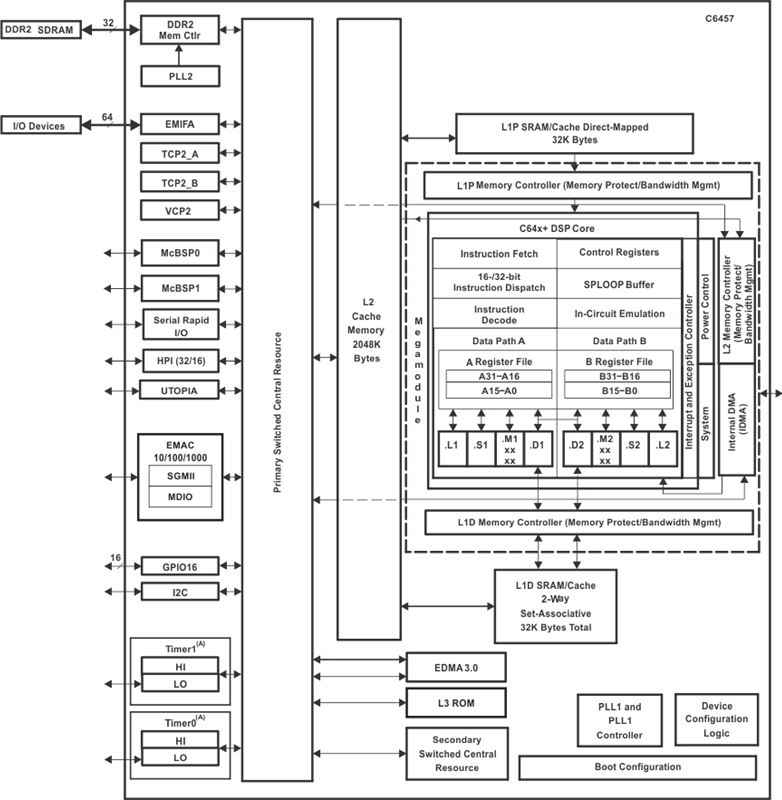
The TMS320C64x+™ DSPs (including the SM320C6457-HIREL device) are the highest-performance fixed-point DSP generation in
the TMS320C6000™ DSP platform. The
SM320C6457-HIREL device is based on the
third-generation high-performance, advanced VelociTI™ very-long-instruction-word (VLIW) architecture
developed by Texas Instruments (TI), making these DSPs an excellent choice for applications
including video and telecom infrastructure, imaging/medical, and wireless infrastructure (WI). The
C64x+ devices are upward code-compatible from previous devices that are part of the C6000™ DSP
platform.
Based on 65-nm process technology and with performance of up to 9600 million instructions per second (MIPS) [or 9600 16-bit MMACs per cycle] at a 1.2-GHz clock rate, the SM320C6457-HIREL
device offers cost-effective solutions to high-performance DSP programming challenges. The
SM320C6457-HIREL DSP possesses the operational
flexibility of high-speed controllers and the numerical capability of array processors.
The C64x+ DSP core employs eight functional units, two register files, and two data
paths. Like the earlier C6000 devices, two of these eight functional units are multipliers or .M
units. Each C64x+ .M unit doubles the multiply throughput versus the C64x core by performing four
16-bit × 16-bit multiply-accumulates (MACs) every clock cycle. Thus, eight 16-bit × 16-bit MACs can
be executed every cycle on the C64x+ core. At a 1.2-GHz clock rate, this means 9600 16-bit MMACs can occur every
second. Moreover, each multiplier on the C64x+ core can compute one 32-bit × 32-bit MAC or four
8-bit × 8-bit MACs every clock cycle.
The SM320C6457-HIREL device includes
Serial RapidIO®. This high-bandwidth peripheral dramatically improves system performance and
reduces system cost for applications that include multiple DSPs on a board, such as video and
telecom infrastructures and medical/imaging.
The SM320C6457-HIREL DSP integrates a
large amount of on-chip memory organized as a two-level memory system. The level-1 (L1) program and
data memories on the SM320C6457-HIREL device are
32KB each. This memory can be configured as mapped RAM, cache, or some combination of the two. When
configured as cache, L1 program (L1P) is a direct mapped cache whereas L1 data (L1D) is a two-way
set associative cache. The level 2 (L2) memory is shared between program and data space and is
2048KB in size. L2 memory can also be configured as mapped RAM, cache, or some combination of the
two. L2 is configurable up to 1MB of cache. The C64x+ Megamodule also has a 32-bit peripheral
configuration (CFG) port, an internal DMA (IDMA) controller, a system component with reset/boot
control, interrupt/exception control, a power-down control, and a free-running 32-bit timer for
time stamp.
The peripheral set includes: an inter-integrated circuit bus module
(I2C); two multichannel buffered serial ports (McBSPs); an 8-bit
Universal Test and Operations PHY Interface for Asynchronous Transfer Mode (ATM) Slave [UTOPIA
Slave] port; two 64-bit general-purpose timers (also configurable as four 32-bit timers); a
user-configurable 16-bit or 32-bit host-port interface (HPI16/HPI32); a 16-pin general-purpose
input/output port (GPIO) with programmable interrupt/event generation modes; an 10/100/1000
Ethernet media access controller (EMAC), which provides an efficient interface between the
SM320C6457-HIREL DSP core processor and the
network; a management data input/output (MDIO) module (also part of the EMAC) that continuously
polls all 32 MDIO addresses in order to enumerate all PHY devices in the system; a glueless
external memory interface (64-bit EMIFA), which is capable of interfacing to synchronous and
asynchronous peripherals; and a 32-bit DDR2 SDRAM interface.
The SM320C6457-HIREL device has three
high-performance embedded coprocessors [one enhanced Viterbi Decoder Coprocessor (VCP2) and two
enhanced Turbo Decoder Coprocessors (TCP2_A and TCP2_B)] that significantly speed up
channel-decoding operations on-chip. The VCP2 operating at CPU clock ÷ 3 can decode more than 694
7.95-Kbps adaptive multi-rate (AMR) [K = 9, R = 1/3] voice channels. The VCP2 supports constraint
lengths K = 5, 6, 7, 8, and 9, rates R = 3/4, 1/2, 1/3, 1/4, and 1/5, and flexible polynomials,
while generating hard decisions or soft decisions. Each TCP2 operating at CPU clock ÷ 3 can decode
up to fifty 384-Kbps or eight 2-Mbps turbo encoded channels (assuming 6 iterations). The TCP2
implements the max*log-map algorithm and is designed to support all polynomials and rates required
by Third-Generation Partnership Projects (3GPP and 3GPP2), with fully programmable frame length and
turbo interleaver. Decoding parameters such as the number of iterations and stopping criteria are
also programmable. Communications between the VCP2/TCP2s and the CPU are carried out through the
EDMA3 controller.
The SM320C6457-HIREL device has a
complete set of development tools, which includes: a new C compiler, an assembly optimizer to
simplify programming and scheduling, and a
Windows® debugger interface
for visibility into source code execution.
- High-Performance Fixed-Point Digital Signal
Processor (DSP) — SM320C6457-HIREL- 1.18-ns, 1-ns, and 0.83-ns Instruction Cycle
Time - 850-MHz and 1-GHz Clock Rate
- Eight 32-Bit Instructions/Cycle
- 8000 and 9600 MIPS/MMACS (16 Bit)
- Extended Case Temperature
- –55°C to 100ºC (1 GHz)
- 1.18-ns, 1-ns, and 0.83-ns Instruction Cycle
- TMS320C64x+™ DSP Core
- Dedicated SPLOOP Instruction
- Compact Instructions (16 Bit)
- Instruction Set Enhancements
- Exception Handling
- TMS320C64x+ Megamodule L1/L2 Memory
Architecture:- 256K-Bit (32Kb) L1P Program Cache [Direct
Mapped] - 256K-Bit (32Kb) L1D Data Cache [2-Way Set-
Associative] - 16M-Bit (2048Kb) L2 Unified Mapped
Ram/Cache [Flexible Allocation]- Configurable up to 1MB of L2 Cache
- 512K-Bit (64Kb) L3 ROM
- Time Stamp Counter
- 256K-Bit (32Kb) L1P Program Cache [Direct
- Enhanced VCP2
- Supports Over 694 7.95-Kbps AMR
- Programmable Code Parameters
- Two Enhanced Turbo Decoder Coprocessors
(TCP2_A and TCP2_B)- Each TCP2 Supports up to Eight 2-Mbps 3GPP
(6 Iterations) - Programmable Turbo Code and Decoding
Parameters
- Each TCP2 Supports up to Eight 2-Mbps 3GPP
- Endianess: Little Endian, Big Endian
- 64-Bit External Memory Interface (EMIFA)
- Glueless Interface to Asynchronous Memories
(SRAM, Flash, and EEPROM) and Synchronous
Memories (SBSRAM, ZBT SRAM) - Supports Interface to Standard Sync Devices
and Custom Logic (FPGA, CPLD, ASICs, and
So Forth) - 32M-Byte Total Addressable External Memory
Space
- Glueless Interface to Asynchronous Memories
- 32-Bit DDR2 Memory Controller (DDR2-667
SDRAM) - Four 1× Serial RapidIO® Links (or One 4×), v1.3
Compliant- 1.25-, 2.5-, 3.125-Gbps Link Rates
- Message Passing, DirectIO Support, Error
Management Extensions, Congestion Control - IEEE 1149.6 Compliant I/Os
- EDMA3 Controller (64 Independent Channels)
- 32-/16-Bit Host-Port Interface (HPI)
- Two 1.8-V McBSPs
- 10/100/1000 Mb/s Ethernet MAC (EMAC)
- IEEE 802.3 Compliant
- Supports SGMII, v1.8 Compliant
- 8 Independent Transmit (TX) and 8 Independent
Receive (RX) Channels
- Two 64-Bit General-Purpose Timers
- Configurable as Four 32-Bit Timers
- Configurable in a Watchdog Timer Mode
- UTOPIA
- UTOPIA Level 2 Slave ATM Controller
- 8-Bit Transmit and Receive Operations up to
50 MHz per Direction - User-Defined Cell Format up to 64 Bytes
- One 1.8-V Inter-Integrated Circuit (I2C) Bus
- 16 General-Purpose I/O (GPIO) Pins
- System PLL and PLL Controller
- DDR PLL, Dedicated to DDR2 Memory Controller
- Advanced Event Triggering (AET) Compatible
- Trace-Enabled Device
- Supports IP Security
- IEEE-1149.1 and IEEE-1149.6 (JTAG™)
Boundary-Scan-Compatible - 688-Pin Ball Grid Array (BGA) Package (GMH
Suffix), 0.8-mm Ball Pitch - 0.065-µm/7-Level Cu Metal Process (CMOS)
- 3.3-V, 1.8-V, 1.1-V I/Os, 1.1-V and 1.2-V Internal
| DSP type | 1 C64x |
| DSP (max) (MHz) | 1000 |
| CPU | 32-/64-bit |
| Operating system | DSP/BIOS |
| Ethernet MAC | 10/100/1000 |
| Rating | HiRel Enhanced Product |
| Operating temperature range (°C) | -55 to 100 |
г. Санкт-Петербург, ул. Софийская 17, лит.А, помещение 3Н оф.230