

Полупроводниковые приборы в России
+7 (812) 240-88-50
+7 (812) 240-88-50
г. Санкт-Петербург, ул. Софийская 17, лит.А, помещение 3Н оф.230
info@texasinst.ru
...
Каталог товаров
Преобразование логики и напряжения
Управление питанием
...
Каталог товаров
Преобразование логики и напряжения
Управление питанием
Поиск
Каталог товаров
Назад
DLP компоненты
Назад
3D scan & machine vision products
Automotive products
Display & projection products
RF & microwave
Назад
Mixers & modulators
RF amplifiers
Wideband transceivers, receivers, transmitters
Аудио
Назад
Audio converters
Audio interface ICs
Specialty audio ICs
Датчики
Назад
Датчики температуры
Магнитные датчики
Радиолокационные датчики миллиметрового диапазона
Драйверы двигателей
Назад
Actuator drivers
Brushless DC (BLDC) motor drivers
Изоляторы
Назад
Isolated interface ICs
Power for signal isolators
Интерфейсы
Назад
Circuit protection ICs
Ethernet ICs
High-speed SerDes
Коммутаторы и мультиплексоры
Микроконтроллеры (MCUs) и процессоры
Преобразование логики и напряжения
Назад
Buffers, drivers & transceiver
Flip-flops, latches & registers
Voltage translators & level shifters
Преобразователи данных
Назад
Аналого-цифровые преобразователи (АЦП)
Интегрированные и специальные функциональные преобразователи данных
Цифроаналоговые преобразователи (ЦАП)
Управление питанием
Назад
AC/DC & isolated DC/DC switching regulators
Battery management ICs
DC/DC switching regulators
Digital power ICs
Gate drivers
MOSFETs
Power over Ethernet (PoE) ICs
Voltage references
Усилители
Назад
Operational amplifiers (op amps)
Назад
Часы и генераторы времени
/ / / / /
SN74HCS74-Q1 Texas instruments
SN74HCS74-Q1 Texas instruments

SN74HCS74-Q1
Уточнить цену
SN74HCS74-Q1
Уточнить цену
СРАВНИТЬ
В СРАВНЕНИИ
Уточнить цену
Описание
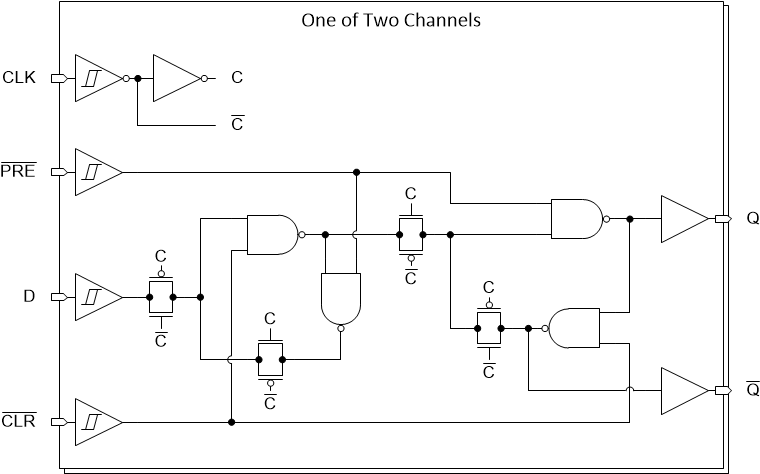
The device contains two independent D-type positive-edge-triggered flip-flops. All inputs include Schmitt triggers, allowing for slow or noisy input signals. A low level at the preset ( PRE) input sets the output high. A low level at the clear ( CLR) input resets the output low. Preset and clear functions are asynchronous and not dependent on the levels of the other inputs. When PRE and CLR are inactive (high), data at the data (D) input meeting the setup time requirements is transferred to the outputs (Q, Q) on the positive-going edge of the clock (CLK) pulse. Clock triggering occurs at a voltage level and is not directly related to the rise time of the input clock (CLK) signal. Following the hold-time interval, data at the data (D) input can be changed without affecting the levels at the outputs (Q, Q).
- AEC-Q100 Qualified for automotive applications:
- Device temperature grade 1: –40°C to +125°C, TA
- Device HBM ESD Classification Level 2
- Device CDM ESD Classifcation Level C6
- Wide operating voltage range: 2 V to 6 V
- Schmitt-trigger inputs allow for slow or noisy input signals
- Low power consumption
- Typical ICC of 100 nA
- Typical input leakage current of ±100 nA
- ±7.8-mA output drive at 6 V
| Number of channels | 2 |
| Technology family | HCS |
| Supply voltage (min) (V) | 2 |
| Supply voltage (max) (V) | 6 |
| Input type | Schmitt-Trigger |
| Output type | Push-Pull |
| Clock frequency (max) (MHz) | 45 |
| IOL (max) (mA) | 7.8 |
| IOH (max) (mA) | -7.8 |
| Supply current (max) (µA) | 2 |
| Features | Balanced outputs, High speed (tpd 10-50ns), Positive input clamp diode |
| Operating temperature range (°C) | -40 to 125 |
| Rating | Automotive |
г. Санкт-Петербург, ул. Софийская 17, лит.А, помещение 3Н оф.230